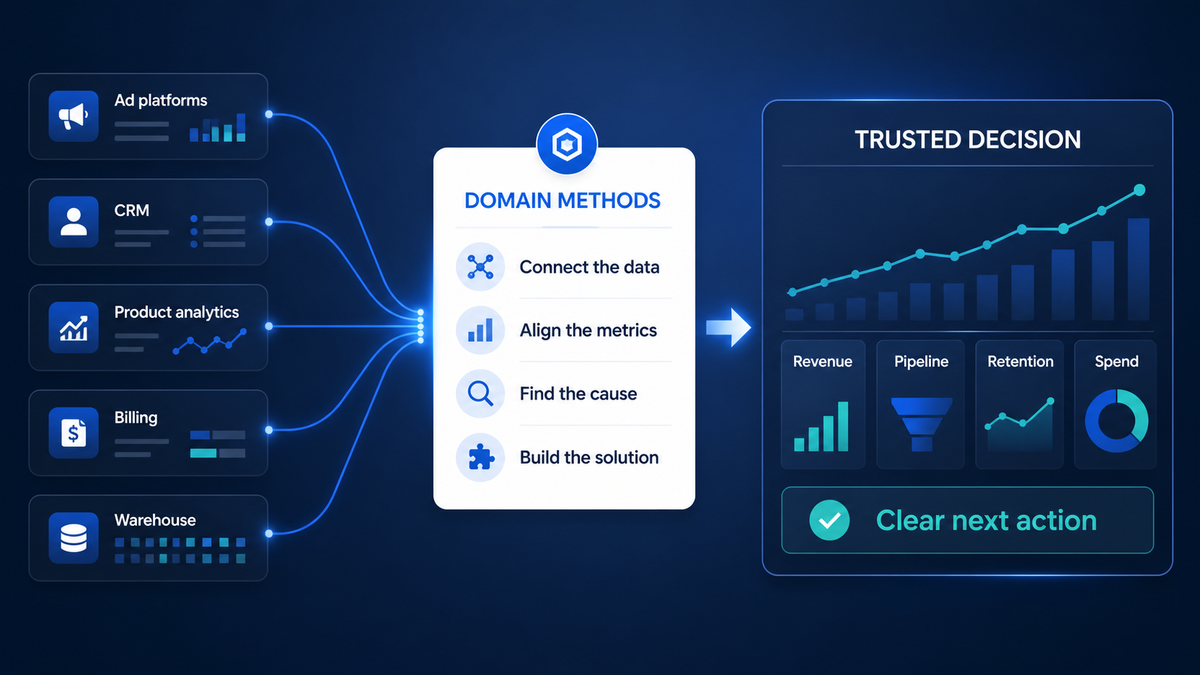
Turn Messy Marketing Data into Decisions that Drive Revenue

Your data should be driving decisions — but conflicting metrics, broken pipelines, and tools nobody trusts are getting in the way. We fix that. Then we turn the cleanup into analytics, workflows, and AI your team can actually trust.

  • Marketing analytics and attribution you can defend
  • Trusted data foundations your team actually uses
  • AI-powered activation built on clean data

For mid-size SaaS and ecommerce teams ($10M+ ARR or venture-funded).

Domain Methods — Turn Messy Marketing Data into Decisions that Drive Revenue

What We Do

Stop Guessing Which Channels Drive Revenue

For the VP of Growth who cannot prove ROAS to the board — and the RevOps team tired of defending numbers that still do not match.

  • Marketing analytics and attribution
  • Revenue operations metrics
  • Cross-channel performance analytics
  • Ad spend optimization
Learn More

Your Dashboards Are Lying. Fix the Foundation.

For data leaders who need more than technical capacity. We make the data trustworthy enough for dashboards, decisions, and AI workflows — without losing the business context that makes the models useful.

  • Data strategy and architecture
  • Pipeline development
  • dbt implementation
  • Data governance and AI readiness
Learn More

Data Sitting in Your Warehouse Isn’t Working

For product and growth teams tired of rich data gathering dust. We ship activation workflows — reverse ETL, scoring, automated audiences — that prove value in weeks, not quarters, and start with one MVP that changes a real decision.

  • Reverse ETL implementation
  • AI-powered predictions and scoring
  • Warehouse-as-CDP solutions
  • Automated activation workflows
Learn More

Exploring AI but not sure your data is ready?

Start with an AI readiness audit

Start with the problem, not the service line

If you know where trust is breaking but do not yet know which engagement fits, start with the diagnostic built for that situation.

Growth / Performance Marketing

Where Did the Money Go?

You are spending aggressively on paid channels and still cannot defend which half of the budget is working.

See the spend diagnostic

Revenue Operations

Three Teams, Three Numbers

Marketing, sales, and finance are all reporting different versions of revenue and nobody trusts the board deck.

See the metric-alignment diagnostic

Product, Analytics, or Growth Leadership

The $500K Question

You are about to bet a quarter of roadmap and growth effort on something that might not move revenue.

See the growth-leverage diagnostic

Head of Data / Analytics

Translate the Ask

The business asked for better analytics, but nobody has translated that into a build plan your team can trust.

See the translation sprint

Ecommerce

Show Me the Margin

Revenue is up, but you still cannot see the real profit by channel, product, and customer segment.

See the profitability diagnostic

Built on tools you already know

dbt
BigQuery
Databricks
Fivetran
dlt
Airbyte
AWS
GCP
Jason B. Hart
Founder & Principal Consultant
“Most companies do not have a dashboard problem or an AI problem first. They have a data trust problem.”

People buy from people

Work directly with the person doing the diagnosing

Most teams I talk to have the same problem: they do not know who to trust and what to do next with the budget they already have. I help mid-size SaaS and ecommerce teams cut through that uncertainty, sort out what is actually broken, and turn messy marketing and revenue data into decisions leadership can use.

  • Former Director of Data & Analytics at Springboard
  • Works across attribution, RevOps, analytics engineering, and AI-readiness diagnostics
  • Hands-on with dbt, BigQuery, Snowflake, Databricks, HubSpot, and Salesforce

Jason B. Hart

Operator, translator, and builder for messy revenue and data questions.

Trusted by data-driven teams

Representative client outcomes from teams that needed clearer numbers, faster decisions, and less dashboard theater.

We name these by role because many clients do not want homepage attribution. The tradeoff is transparency over polish: each card includes operating context, engagement scope, and a proof path to the closest published case study.

60% → 95% attribution coverage

Anonymized client outcome

B2B SaaS + Attribution Rebuild = One Number Marketing and Finance Both Trust

We were spending six figures a month on ads with no way to tell which channels were actually driving pipeline. Domain Methods rebuilt our attribution model from the ground up — unified data from ad platforms, CRM, and billing into one trusted pipeline. We went from defending numbers in every board meeting to making budget allocation decisions in hours.
VP of Growth 300-person B2B SaaS company with a seven-figure paid media budget Attribution rebuild across ad platforms, CRM, and billing
VOG

VP of Growth

300-person B2B SaaS company with a seven-figure paid media budget

99%+ pipeline uptime

Anonymized client outcome

Mid-Market SaaS + dbt Foundation = Pipeline Reliability Nobody Has to Think About

Most consultants could write SQL but couldn’t explain why it mattered to the business. Domain Methods built a dbt foundation with real governance — tested models, clear documentation, and automated quality checks. Our team went from constant firefighting to barely thinking about pipeline reliability.
Head of Data 200-person mid-market SaaS team with a brittle dbt stack dbt foundation, testing, and warehouse governance reset
HOD

Head of Data

200-person mid-market SaaS team with a brittle dbt stack

5 dashboards → 1 source of truth

Anonymized client outcome

B2B SaaS + Flexible Data Model = CRO and CFO Looking at the Same Metrics

We had five dashboards showing five different revenue numbers. Domain Methods didn’t just pick one — they built a flexible data model that adapts as our business changes. For the first time, our CRO and CFO look at the same metrics. That alignment alone was worth the engagement.
VP of Revenue Operations Workforce management platform with sales, finance, and RevOps all reporting different revenue numbers Revenue model redesign and cross-functional metric alignment
VOR

VP of Revenue Operations

Workforce management platform with sales, finance, and RevOps all reporting different revenue numbers

18% churn reduction in 3 weeks

Anonymized client outcome

PLG SaaS + Reverse ETL MVP = Churn Reduction in Three Weeks

I didn’t want a six-month roadmap — I wanted to prove that our warehouse data could reduce churn this quarter. Domain Methods shipped a reverse ETL workflow in three weeks that synced churn-risk scores to our CRM and triggered automated outreach. It moved the needle immediately. That MVP approach is exactly what PLG teams need.
Head of Product PLG SaaS business with 15,000 active accounts and churn pressure on expansion revenue Reverse ETL MVP for churn-risk scoring and CRM activation
HOP

Head of Product

PLG SaaS business with 15,000 active accounts and churn pressure on expansion revenue

2-week AI readiness roadmap

Anonymized client outcome

SaaS Data Team + AI Readiness Audit = Clarity Before Buying Another AI Tool

Leadership wanted AI use cases fast, but our definitions, source quality, and documentation were not ready. Domain Methods audited the stack, showed us exactly what to fix first, and gave us a practical roadmap. Instead of forcing AI onto messy data, we cleaned up the foundation and moved with confidence.
VP of Data Healthcare analytics company under pressure to show AI value without breaking reporting trust AI readiness audit and two-week foundation roadmap
VOD

VP of Data

Healthcare analytics company under pressure to show AI value without breaking reporting trust

Proof for the situations we talk about

A few representative examples of what happens when messy marketing and revenue data gets connected to decisions leaders can actually act on.

Growth / Attribution

From conflicting dashboards to one trusted attribution pipeline

A 300-person SaaS growth team stopped arguing with finance and started making budget decisions in hours.

We unified ad platforms, CRM, and billing data into one attribution pipeline the growth team and finance team could both trust.

Read case study

Product-Led Growth / Activation

A churn-reduction workflow shipped in 3 weeks

Warehouse data moved from passive reporting to a live retention workflow.

A PLG SaaS team used reverse ETL and churn-risk scoring to get high-signal accounts into the CRM fast enough to act.

Read case study

Ecommerce / Profitability

True channel-level ROAS cut wasted ad spend 35%

A DTC brand stopped trusting platform-reported vanity numbers and started reallocating budget based on real outcomes.

We connected ad spend, Shopify revenue, and downstream outcomes so the team could see which channels were actually profitable.

Read case study

Common questions before reaching out

What does Domain Methods actually do?

Domain Methods helps mid-size SaaS and ecommerce teams fix messy marketing, revenue, and analytics data so leadership can trust the numbers again. That usually means diagnosing attribution gaps, cleaning up definitions and data flows, building a more trustworthy warehouse and reporting foundation, and then turning that foundation into useful workflows or AI-enabled activation.

Who is the best fit for Domain Methods?

The best fit is usually a SaaS company around 150–500 employees, or a similarly complex ecommerce business, where growth, finance, RevOps, and data teams are all feeling the pain of conflicting numbers or underused warehouse data. The common pattern is urgency: a leadership team needs answers now, but internal trust in the data is weak.

Should we start with a diagnostic or a larger engagement?

If you know something is broken but you cannot yet name the real failure point, start with a diagnostic. If you already know the operating problem and need the underlying systems, models, or workflows built, a larger service engagement usually makes more sense. The site routes both paths on purpose because most teams need clarity before they need more implementation hours.

Can Domain Methods help with AI projects if the data is still messy?

Yes, but usually by getting honest first about whether the data is ready. Sometimes the right answer is to improve source reliability, definitions, and workflow fit before adding AI. Other times there is a small, high-leverage activation use case worth shipping right away. The point is to avoid AI theater built on untrusted inputs.

Practical data insights, monthly

One email per month with actionable takes on attribution, data foundations, and AI-powered activation — drawn from real client work. No fluff, no spam.

Book a Discovery Call